
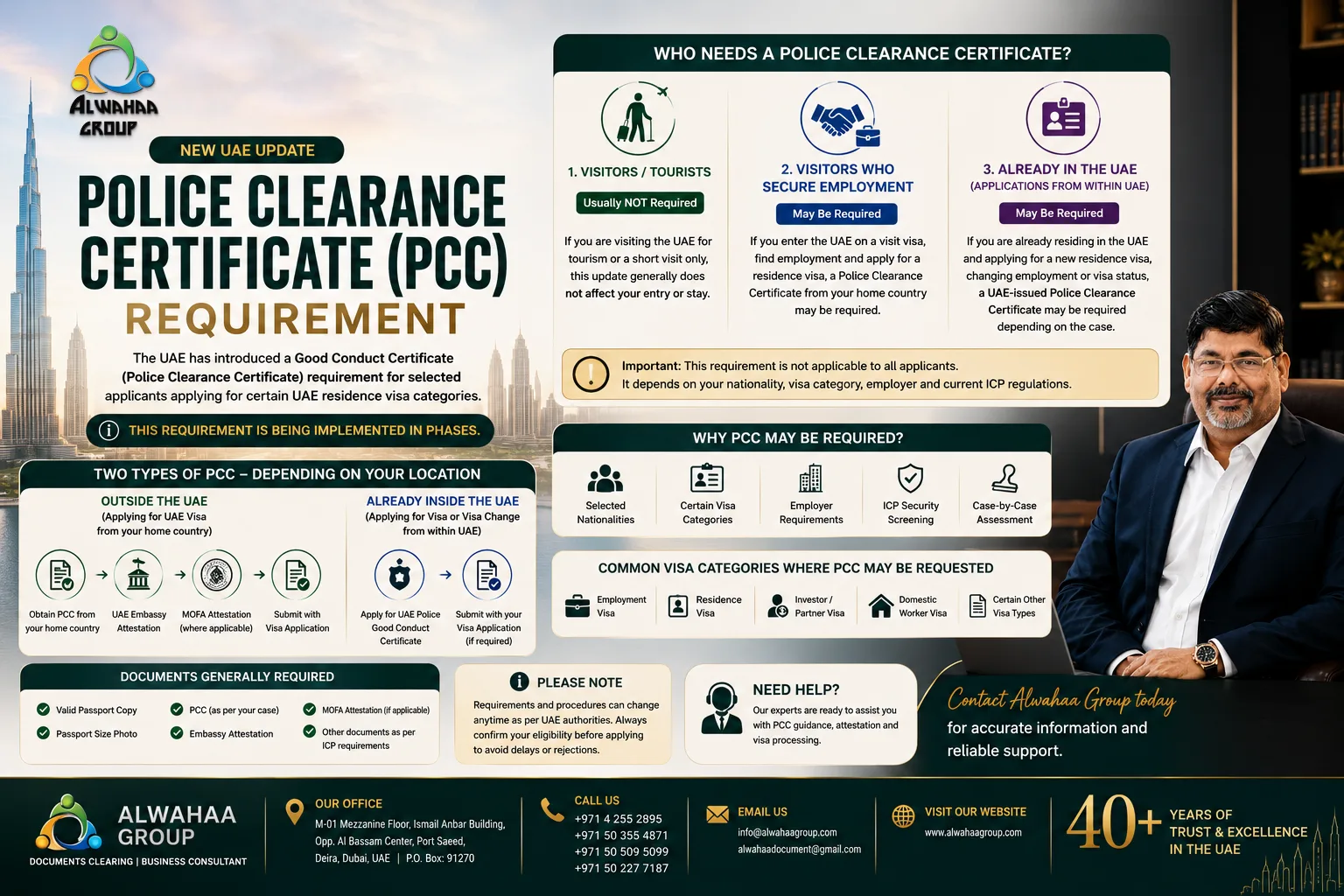
The UAE's Federal Authority for Identity, Citizenship, Customs and Port Security (ICP) has begun phasing in a Good Conduct Certificate — commonly called a Police Clearance Certificate (PCC) — for selected visa applicants. A Good Conduct Certificate may be required for selected applicants; it is not a blanket requirement for everyone.
The requirement is being introduced in phases. It applies to selected nationalities and eligible visa categories — not to all visitors and not to all employment visas.
What changed?
For some visa files, the ICP may now ask for an attested Good Conduct Certificate before a residence or employment visa is completed. Whether it applies is not automatic — it may be required depending on:
- Nationality
- Visa category
- Employer
- ICP requirements
- Security screening
Who is affected — and who is not?
Who may need a PCC?
- Applicants from selected nationalities
- Certain employment visa applicants
- Certain residence visa applicants
- Some investor / business visa applicants
Who is generally not affected?
- Most tourists and short-term visitors
- Short visits with no visa status change
If you are visiting the UAE for tourism or a short stay, this requirement generally does not affect your entry — you can come, visit and leave as normal.
Visitors who secure employment
The most common question comes from people who enter on a visit visa, find a job, then convert to an employment visa. In this case a Good Conduct Certificate may be requested before the file is completed — depending on the factors above. If it is requested, it usually needs to come from your home country and be attested for UAE use.
Residents changing visa status
If you are already inside the UAE and applying for a new residence visa — including a job change or a fresh application — you may also be asked for an attested Good Conduct Certificate. Again, it depends on nationality, visa category, employer and the latest ICP regulations.
The two PCC scenarios
This is where most of the confusion sits. There are two different routes depending on where you are:
Outside the UAE
Already inside the UAE
Note: the new visa rule is set by the ICP. A UAE-issued Good Conduct Certificate itself is obtained through Dubai Police or the relevant emirate authority by eligible applicants.
Nationalities currently reported under the phased implementation
The following nationalities have been reported under the current phase:
- Afghanistan, Algeria, Bhutan, Bulgaria, Cameroon
- Cuba, Egypt, Ethiopia, Gambia, Ghana
- India, Iraq, Lebanon, Lithuania, Mexico
- Morocco, Mozambique, Nepal, Pakistan, Senegal
- Somalia, Sri Lanka, Syria, Tonga, Uganda
The list may change as the ICP expands the phased rollout. Treat it as current guidance, not a fixed rule, and confirm your own case before applying.
Required documents
Where a Good Conduct Certificate is requested, applicants are commonly asked for:
- Clear passport copy
- Current UAE visa / visit visa or previous residence details where available
- Emirates ID copy if you currently have, or previously had, UAE residency
- Recent passport-size photograph
- Fingerprint card or embassy / police verification where you are outside the UAE
- Legal translation and attestation if a foreign certificate is not accepted in its original format
Step-by-step attestation process (home-country PCC)
- Obtain the certificate from the relevant police or government authority in your home country.
- Legal translation into Arabic / English where required.
- UAE Embassy or Consulate attestation in the issuing country.
- MOFA attestation in the UAE, where applicable.
- Submit with the visa or employment file.
Because the certificate is issued abroad, arranging it early — ideally before you travel — keeps attestation from holding up your start date.
Important
The Good Conduct Certificate (Police Clearance Certificate) requirement is being implemented in phases by UAE authorities.
Eligibility depends on nationality, visa category, employer requirements and the latest ICP regulations.
Contact Alwahaa before applying to confirm whether this requirement applies to your case.
Frequently asked questions
Is the Good Conduct Certificate mandatory for everyone?
No. It may be required for selected applicants under the ICP's phased rollout. Most tourists and short-term visitors are generally not affected.
I'm on a visit visa and got a job offer — do I need one?
Possibly. It depends on your nationality, visa category, employer and ICP requirements. Check before the employment file is submitted so attestation does not cause delays.
Where do I get a UAE Good Conduct Certificate?
Eligible applicants inside the UAE can obtain one through Dubai Police or the relevant emirate authority, then submit it with the application if requested.
How long does attestation take?
A UAE-issued certificate is usually faster. A home-country certificate takes longer because it may involve home police systems, embassy coordination, MOFA attestation, courier handling and legal translation.
How Alwahaa helps
Alwahaa Documents Clearing LLC checks whether a Good Conduct Certificate is likely to be needed for your case, confirms whether it should be UAE-issued or home-country issued, prepares the application, coordinates translation and attestation, and follows up so the visa file does not sit idle.
Send us your nationality, visa stage, employer details and previous UAE residence history, and our desk will advise the correct route before the file is submitted.
Contact Alwahaa
For live requirements always confirm through official UAE channels — the ICP and the specific authority handling your file — or speak to the Alwahaa desk on +971 4 255 2895 / WhatsApp.